
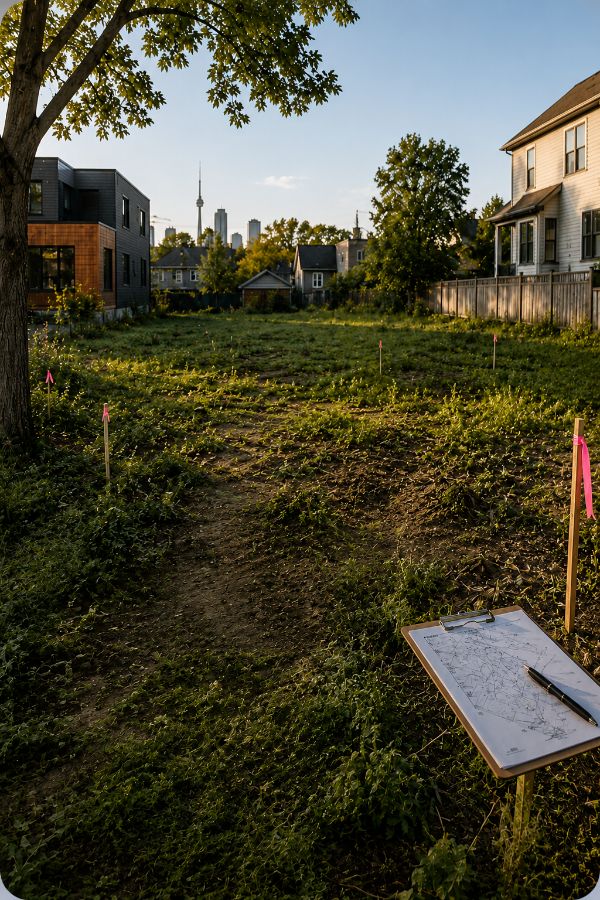
07 Aug How to Evaluate a Vacant Lot
A vacant lot may look simple. Determining what can actually be built on it is not.
Before purchasing land or beginning a development concept, it is important to understand the physical, regulatory, financial, and market conditions that affect the property.
At HAUS 121, we believe the right development starts with the right questions. A thoughtful lot evaluation can help identify opportunities early, uncover potential constraints, and determine whether a property deserves further investment.
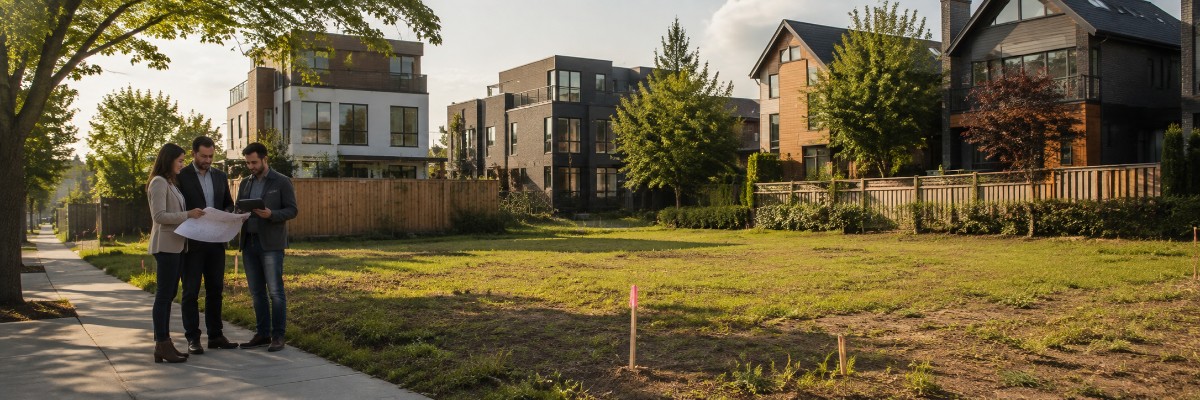
Is the Lot Actually Buildable?
A vacant parcel does not automatically mean a home or development can be constructed on it.
The first step is determining whether the property can reasonably support the type of project being considered.
That requires looking beyond the listing description and evaluating factors such as:
- Zoning
- Lot dimensions
- Setbacks
- Lot coverage
- Building height
- Density
- Access
- Utilities
- Easements
- Topography
- Drainage
- Flood conditions
- Soil conditions
- Historic or environmental restrictions
The goal is not simply to determine whether something can be built. It is to understand what can be built, how much can be built, and whether the project still makes sense after the constraints are considered.
01 — Start With Zoning
Zoning is one of the most important parts of evaluating a vacant lot.
The zoning designation can influence:
- Permitted uses
- Number of dwelling units
- Building height
- Required setbacks
- Lot coverage
- Parking
- Density
- Accessory dwelling units
- Subdivision possibilities
- Building configuration
A property may appear large enough for several homes while zoning allows significantly less development.
Conversely, a small urban parcel may permit more housing than its size initially suggests.
Always review the current zoning and applicable development standards before relying on assumptions about what the property can support.
02 — Confirm the Lot Dimensions and Boundaries
The advertised acreage or square footage tells only part of the story.
The shape and dimensions of the parcel can dramatically affect what can actually be built.
Important questions include:
- How wide is the lot?
- How deep is it?
- Is the lot rectangular or irregular?
- Where are the actual property lines?
- Are there encroachments?
- Are there recorded easements?
- Does the property have sufficient frontage?
- Is there adequate access from a public street?
A current boundary survey may be necessary to confirm these conditions.
A 5,000-square-foot rectangular lot may provide greater development flexibility than a larger property with an unusual shape, limited frontage, or significant easements.
03 — Understand the Building Envelope
Once the property boundaries and zoning requirements are understood, the next question becomes:
Where can the building actually go?
Front, side, and rear setbacks can reduce the usable portion of a site considerably.
Lot coverage restrictions, height limits, required yards, parking requirements, tree-preservation requirements, and other regulations may further define the building envelope.
This is particularly important for narrow urban infill lots where every foot matters.
A preliminary site or zoning analysis can help illustrate the portion of the property that may realistically be available for development.
04 — Check Water, Sewer and Utilities
Utility availability can have a major impact on development cost.
Determine whether the property has reasonable access to:
- Public water
- Public sewer
- Electricity
- Natural gas, where applicable
- Stormwater infrastructure
- Telecommunications
Do not assume utilities are available simply because neighboring homes have service.
The location and capacity of existing utility lines should be confirmed.
A project requiring a new sewer connection, utility extension, upgraded service, well, septic system, or significant infrastructure work may have substantially different economics than a lot with readily accessible services.
05 — Look at Topography and Drainage
A flat lot and a steeply sloped lot can have very different construction requirements.
Topography can influence:
- Foundation design
- Excavation
- Retaining walls
- Site access
- Drainage
- Stormwater management
- Driveway design
- Construction cost
A sloped property is not necessarily a bad development site. In some cases, topography can create opportunities for walkout basements, lower-level garages, or unique architectural solutions.
However, the site conditions need to be understood before the project is priced.
06 — Check Flood Risk and Stormwater Conditions
Water can significantly affect whether and how a site is developed.
Potential concerns may include:
- Floodplain designation
- Floodways
- Poor drainage
- Existing streams
- Wetlands
- High groundwater
- Stormwater-management requirements
Flood information should be reviewed as part of the early evaluation process, and local requirements may go beyond what is visible from a basic property search.
Drainage conditions should also be considered even when the property is not located within a mapped flood zone.
07 — Understand the Soil and Ground Conditions
What is below the property can be just as important as what is above it.
Soil conditions may affect:
- Foundation requirements
- Bearing capacity
- Drainage
- Excavation
- Septic suitability
- Retaining structures
- Construction costs
Public soil information can provide an early indication of potential conditions, but detailed engineering or geotechnical investigation may be needed for a specific development.
The USDA Natural Resources Conservation Service notes that soil surveys can help developers identify soil-related hazards or limitations that may affect homesites and other construction.
08 — Look for Easements and Other Property Restrictions
A vacant lot may contain areas that cannot be built upon even though they are technically part of the property.
Potential restrictions can include:
- Utility easements
- Access easements
- Drainage easements
- Conservation easements
- Shared driveways
- Rights-of-way
- Private covenants
- HOA restrictions
- Historic preservation requirements
- Building restriction lines
Title documents and a survey can help identify recorded restrictions.
These items should be understood before determining the property’s true development potential.
09 — Consider Environmental Conditions
The property’s current appearance does not always reveal how it was used in the past.
Depending on the property and its history, environmental review may be appropriate—particularly for sites with prior commercial, industrial, automotive, manufacturing, dumping, or other potentially contaminating uses.
Environmental due diligence may investigate previous uses of the property and surrounding land to identify potential concerns before acquisition.
10 — Study the Surrounding Neighborhood
A technically buildable lot is not automatically a good development opportunity.
The surrounding market also matters.
Look at:
- Existing housing types
- Recent sales
- New construction
- Rental demand
- Home values
- Lot values
- Neighborhood character
- Schools and amenities
- Employment centers
- Transportation
- Planned development nearby
For an infill project, it is especially important to understand how the proposed property would relate to the surrounding block.
The most successful project is often not the largest building that can legally fit on the property. It is the project that makes sense for the site, neighborhood, market, and economics.
What Makes a Vacant Lot Attractive for Development?
While every site is different, several characteristics can strengthen a development opportunity.
A promising property may have:
- Favorable zoning
- Useful lot dimensions
- Adequate street frontage
- Public water and sewer access
- Limited easements
- Manageable topography
- Strong surrounding property values
- Demand for new housing
- A purchase price that supports development economics
- A clear path to approvals and construction
No single factor determines whether the property is a good opportunity.
The conditions must work together.
What Are Common Red Flags When Evaluating Vacant Land?
A low-priced lot is not always a bargain.
Potential warning signs can include:
- No legal access
- Extremely narrow dimensions
- Significant slopes
- Floodplain or wetland conditions
- Limited sewer or water availability
- Large utility easements
- Unusual title restrictions
- Expensive site work
- Difficult zoning
- Environmental concerns
- Required retaining walls
- Significant tree-removal limitations
- Development costs that exceed the property’s potential value
The purchase price is only one piece of the development equation.
How Do You Know How Many Homes Can Be Built?
This usually requires more than dividing the total acreage by a minimum lot size.
Potential density can be affected by:
- Zoning
- Minimum lot dimensions
- Road frontage
- Setbacks
- Open-space requirements
- Stormwater facilities
- Utility locations
- Topography
- Parking
- Access
- Subdivision standards
- Fire and emergency access
- Environmental conditions
For larger properties, a preliminary yield study or conceptual site plan can provide a more realistic estimate of development capacity.
Should You Get a Survey Before Buying a Vacant Lot?
In many situations, a current survey is extremely valuable.
A survey can help confirm:
- Property boundaries
- Dimensions
- Improvements
- Easements
- Rights-of-way
- Encroachments
- Access
- Other physical conditions affecting the parcel
Depending on the project, additional survey work such as a topographic survey, ALTA/NSPS survey, or subdivision plat may later be required.
Do You Need a Soil Test?
It depends on the property and proposed development.
For some projects, existing information may be enough for an initial feasibility review. Other sites may require geotechnical testing or additional investigation before foundation design or site engineering can be finalized.
Properties that rely on private septic systems may also require soil or percolation testing to determine whether an acceptable wastewater system can be installed.
Should You Check the Flood Zone?
Yes.
Flood conditions can affect site design, insurance, financing, building elevations, development costs, and potentially whether portions of a property can be used.
FEMA’s Flood Map Service Center is the official public source for National Flood Insurance Program flood-hazard information, although local agencies may have additional floodplain or stormwater requirements.
What Should Be Evaluated Before Making an Offer?
Ideally, a buyer should understand as much as reasonably possible about the property’s development potential before becoming fully committed to the purchase.
Depending on the transaction, due diligence may include:
Zoning Review
What is permitted today?
Survey Review
Where are the boundaries, easements, and restrictions?
Utility Review
Can the project connect to required services?
Site Review
Are slope, drainage, soils, trees, or access likely to create significant costs?
Environmental Review
Are there prior uses or conditions that warrant investigation?
Conceptual Development Review
What might realistically fit on the site?
Market Review
Who is the project being built for and what will the market support?
Preliminary Financial Review
Does the projected value justify acquisition, design, permitting, site work, construction, financing, and contingency costs?
The purpose of due diligence is to reduce uncertainty before significant money is invested.
What Professionals May Be Needed?
Depending on the property and project, the evaluation team may include:
- Architect
- Land surveyor
- Civil engineer
- Structural engineer
- Geotechnical engineer
- Environmental professional
- Land-use or zoning professional
- Utility consultant
- General contractor or builder
- Real estate attorney
- Title company
- Lender or development finance professional
Not every property requires every specialist.
The purpose of an early feasibility review is to identify which expertise is actually needed.
How HAUS 121 Approaches Vacant Lot Evaluation
At HAUS 121, we begin with the site before we begin with the building.
01 — Understand
We look at the property, surrounding neighborhood, ownership goals, zoning framework, and development opportunity.
02 — Evaluate
We identify the major questions that could affect feasibility—including site constraints, development potential, infrastructure, design direction, and market considerations.
03 — Conceptualize
Where appropriate, we explore what type and scale of housing may fit the property and its context.
04 — Test Feasibility
The concept must make sense not only architecturally, but financially.
Acquisition, soft costs, site work, construction, financing, contingency, projected value, and market demand should be considered together.
05 — Determine the Path Forward
If the opportunity is viable, the project can advance into surveys, architecture, engineering, entitlements or approvals, permitting, financing, and construction.
Before You Buy the Lot, Understand the Opportunity.
The most important question is not:
“How cheap is the land?”
It is:
“What can realistically be created here—and does the opportunity make sense?”
A thoughtful feasibility review can help answer that question before a vacant property becomes an expensive surprise.
Have a Vacant Lot or Development Opportunity?
HAUS 121 works with property owners, investors, and development partners to explore infill, residential redevelopment, and housing opportunities.

No Comments